Monthly
$9.99 per month
Everything Assetprint offers, billed month to month.
Get started monthly

Assetprint is a simple, comprehensive inventory of your financial assets. It organizes what you own, shows which accounts are set up to pass outside probate, and keeps the record ready for the person who will need it.
What goes in
For each account you record the institution, how the account is titled, the beneficiary if there is one, the last four digits of the account number, and its value. Never the full account number, and never a login.
Individual, joint with rights of survivorship, payable on death, corporate
Brokerage and advisory accounts, including transfer on death registrations
IRAs of every kind, 401(k), 403(b), 457, pensions, Thrift Savings Plan
UGMA and UTMA custodial accounts and 529 plans
Trusts under agreement or under will, corporations, LLCs
Residences, investment property, land, vehicles, collectibles, precious metals, cryptocurrency
Whole, term, universal, and variable life policies, with the death benefit
Will, trust agreement, durable and healthcare powers of attorney, tax returns, and where to find them
Probate Intelligence
Whether an account goes through probate depends mostly on two things: how it is titled, and whether a beneficiary is named. Assetprint reads both for every account you enter and marks the result.
Bypasses probate Subject to probate
Most people discover the difference after a death, when a brokerage account titled in one name alone has to wait for the court while the same account with a transfer on death registration would have passed with a death certificate. Assetprint shows the difference now, while it can still be changed.
Probate Intelligence is an estimate based on the titling and beneficiary information you enter. State law and institution procedures vary. It is not legal advice; confirm changes to how an account is titled with a qualified professional.
| Account as set up | Result |
|---|---|
| Brokerage account, individual | Subject to probate |
| Brokerage account, individual with transfer on death | Bypasses probate |
| Checking account, joint with rights of survivorship | Bypasses probate |
| IRA or 401(k) with a named beneficiary | Bypasses probate |
| Life insurance with a named beneficiary | Bypasses probate |
| Real estate, tenants in common | Subject to probate |
| Real estate held in a trust or an LLC | Bypasses probate |
The Third Executor
Your Third Executor is the person you choose to receive your Assetprint when the time comes. They are not your legal executor and they hold no authority over your accounts; they hold the map.
The Assetprint PDF
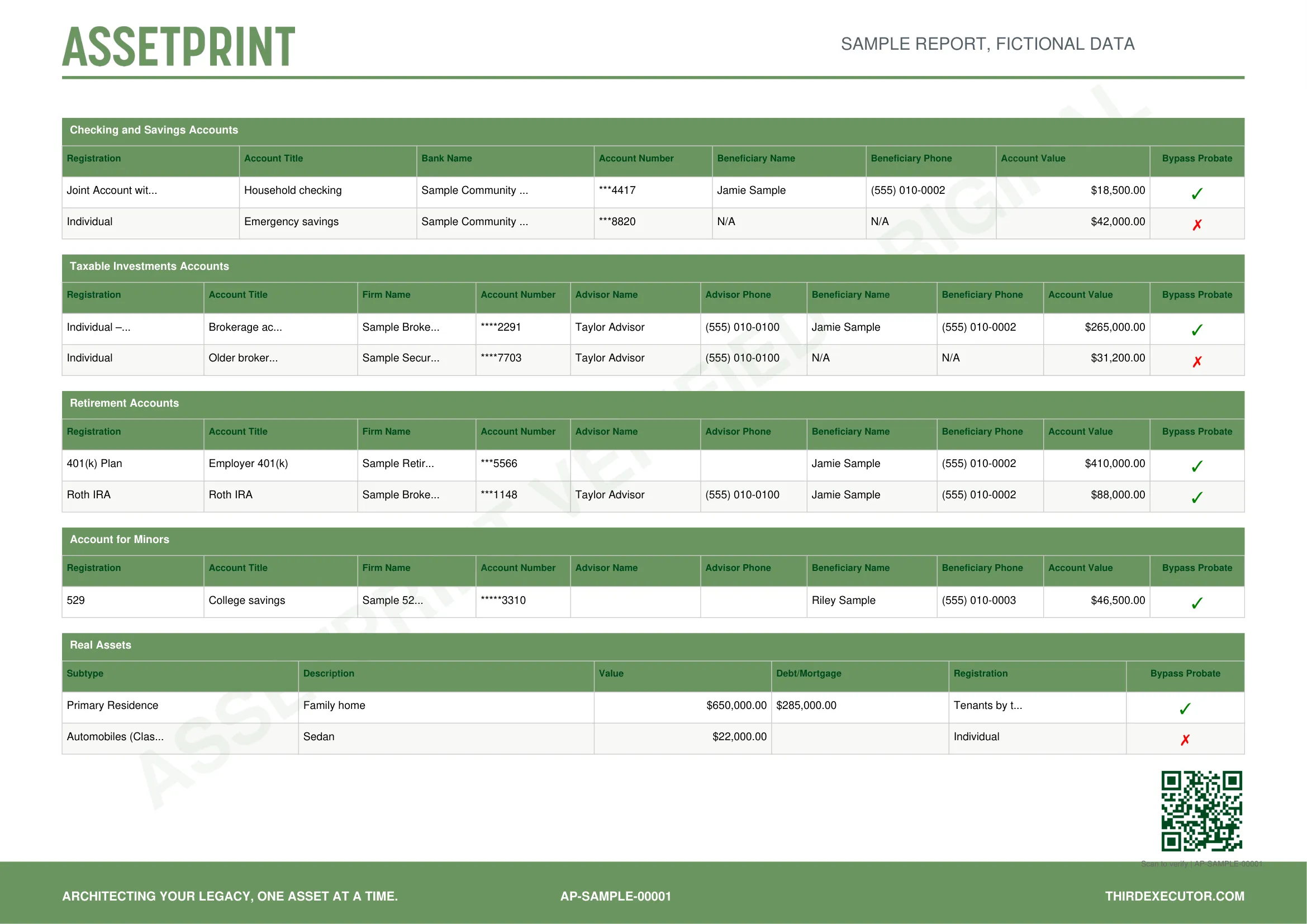

Every Assetprint PDF carries a document ID, a watermark, and a QR code that links to a verification page. The page recomputes the document's fingerprint and reports one of three results: verified, integrity issue, or not found. Anyone holding the printed report can check it; nobody can learn anything from the check beyond the document's status and the name it was prepared for.
Treat printed reports like the sensitive documents they are. The verification link is the way to tell an original from a copy that has been edited.
The Legacy Simulator shows how your assets are set up to move to the people you have named, and estimates what probate would cost your family if nothing changed, using published state fee schedules.
How it works
Add your bank accounts, investments, retirement accounts, insurance policies, real assets, and important documents. Entry is manual, so nothing connects to your institutions.
Choose a trusted person to hold access to your financial blueprint. They are notified and asked to confirm, but they have no access until the time comes.
Download your complete Assetprint PDF. Review it with your family and keep it with your other important papers.
Your Third Executor receives a secure notification with instructions for accessing your Assetprint when the time comes.
After a death is reported and a death certificate is reviewed, your Third Executor receives the complete, organized record of what exists and where.
Data security
Assetprint collects the minimum it needs to outline your assets and assess probate status, and it never asks for a full account number or an online banking login.
All traffic to the service is encrypted with HTTPS and HSTS.
The app accepts at most the last four characters of an account number, and its storage is built so that a full number cannot be saved in that field.
Passwords are stored only as one-way bcrypt hashes.
Uploaded documents live outside the public web directory and are served only through authenticated, access-controlled requests. Administrative access is restricted to authorized reviewers.
A Third Executor claim is reviewed by a person after a death certificate is uploaded. No automated system or AI analyzes your documents.
Card details go to Stripe. Assetprint receives only a customer identifier and subscription status.
No security description is a guarantee. The full statement is in the Assetprint privacy policy.
Pricing
Full Probate Intelligence, Third Executor protection, and an authenticated report. Pay monthly or save with annual.
$9.99 per month
Everything Assetprint offers, billed month to month.
Get started monthlyBest value
$99 per year
The same full access, two months free when you pay annually.
Get started annualNo free tier. Cancel at any time from the billing portal in your account. Prices shown in US dollars; taxes may apply.
Complete it at your own pace, update it whenever something changes, and keep it ready for the person who will need it.
Assetprint is an asset organization tool. It does not provide financial, legal, or estate planning advice. Consult a qualified professional for personalized guidance. Third Executor, LLC does not act as an executor, trustee, or fiduciary.